 Add to Chrome
 Add to Firefox
 Add to Edge
Models That Know How Evaluations Are Designed Score Safer
May 27, 2026
The validity of AI safety evaluations depends on models behaving consistently across controlled and deployment settings. Prior work has identified test-time contextual cues, such as hypothetical scenarios, as a source of verbalized evaluation awareness and subsequent behavioral shift. In this paper, we investigate a potential explanation of this phenomenon: evaluation meta-knowledge, defined as parametric knowledge about the structural traits that characterize evaluations. Similar to dataset contamination, where benchmark exposure leads to higher performance through memorization, we hypothesize that models trained on texts describing evaluation practices may implicitly learn to recognize and respond to evaluation-like contexts, for instance, through exposure to scientific articles or social media posts about AI benchmarking. To test this, we fine-tune models on synthetic documents describing evaluation traits such as verifiable structures or moral dilemmas. Evaluating this fine-tuned model on six safety benchmarks, we find that it is significantly safer than the base model and control model. This behavioral shift persists even when restricting the analysis to responses lacking explicit verbalization of evaluation awareness. Our results demonstrate that evaluation meta-knowledge may inflate safety benchmark performance, introducing a novel confounder that is independent of explicit memorization or verbalized evaluation awareness, thus, challenging to detect. These findings have important implications for the design and interpretation of AI safety evaluations. Our code and models are available at https://github.com/compass-group-tue/arxiv2026_evaluation_meta_knowledge.

Measuring Security Without Fooling Ourselves: Why Benchmarking Agents Is Hard
May 21, 2026The benchmarks used to evaluate AI agents in security-critical roles suffer from crucial weaknesses. Building on recent empirical evidence, we characterize three core challenges that undermine security evaluations: benchmark vulnerabilities, temporal staleness, and runtime uncertainty. We then outline practical directions toward building more robust and trustworthy evaluation frameworks.
Decomposing and Measuring Evaluation Awareness
May 21, 2026Frontier language models sometimes recognize that they are being evaluated and adjust their behavior, undermining validity of benchmark results. Yet the field studies it without a shared foundation, conflating properties of the evaluation with properties of the model, and detection with behavioral response. We ground evaluation awareness in social psychology, decomposing it into an environment component (how recognizable the task is) and a model component that separates recognition from propensity to act on it. We operationalize the environment component through eight categorized trigger factors, such as placeholder entities and grading-style output formats, and study recognition and behavior through chain-of-thought monitoring. Across nine frontier models and four benchmarks, recognition rates depend on the specific pairing of model and benchmark rather than on either in isolation. Recognition rarely leads to behavioral change, and when it does, the direction depends on the type of evaluation perceived. Models are also more sensitive to safety than capability evaluations, placing safety benchmark validity at greater risk. To study which factors each model is sensitive to and how they interact, we propose \textbf{EvalAwareBench}, a factor-controlled benchmark of 100 paired safety-capability tasks where each of the eight factors can be independently toggled, varying evaluative signals while holding the underlying request fixed. Through EvalAwareBench, we find that no single factor uniformly affects all models, but stacking factors progressively raises evaluation awareness across all of them. Our framework and EvalAwareBench provide the tools to measure, attribute, and mitigate evaluation awareness, pointing to behavioral consistency under recognition as a promising path forward.
No More, No Less: Task Alignment in Terminal Agents
May 12, 2026Terminal agents are increasingly capable of executing complex, long-horizon tasks autonomously from a single user prompt. To do so, they must interpret instructions encountered in the environment (e.g., README files, code comments, stack traces) and determine their relevance to the task. This creates a fundamental challenge: relevant cues must be followed to complete a task, whereas irrelevant or misleading ones must be ignored. Existing benchmarks do not capture this ability. An agent may appear capable by blindly following all instructions, or appear robust by ignoring them altogether. We introduce TAB (Task Alignment Benchmark), a suite of 89 terminal tasks derived from Terminal-Bench 2.1. Each task is intentionally underspecified, with missing information provided as a necessary cue embedded in a natural environmental artifact, alongside a plausible but irrelevant distractor. Solving these tasks requires selectively using the cue while ignoring the distractor. Applying TAB to ten frontier agents reveals a systematic gap between task capability and task alignment. The strongest Terminal-Bench agent achieves high task completion but low task alignment on TAB. Evaluating six prompt-injection defenses further shows that suppressing distractor execution also suppresses the cues required for task completion. These results demonstrate that task-aligned agents require selective use of environmental instructions rather than blanket acceptance or rejection.
Skill-Inject: Measuring Agent Vulnerability to Skill File Attacks
Feb 25, 2026LLM agents are evolving rapidly, powered by code execution, tools, and the recently introduced agent skills feature. Skills allow users to extend LLM applications with specialized third-party code, knowledge, and instructions. Although this can extend agent capabilities to new domains, it creates an increasingly complex agent supply chain, offering new surfaces for prompt injection attacks. We identify skill-based prompt injection as a significant threat and introduce SkillInject, a benchmark evaluating the susceptibility of widely-used LLM agents to injections through skill files. SkillInject contains 202 injection-task pairs with attacks ranging from obviously malicious injections to subtle, context-dependent attacks hidden in otherwise legitimate instructions. We evaluate frontier LLMs on SkillInject, measuring both security in terms of harmful instruction avoidance and utility in terms of legitimate instruction compliance. Our results show that today's agents are highly vulnerable with up to 80% attack success rate with frontier models, often executing extremely harmful instructions including data exfiltration, destructive action, and ransomware-like behavior. They furthermore suggest that this problem will not be solved through model scaling or simple input filtering, but that robust agent security will require context-aware authorization frameworks. Our benchmark is available at https://www.skill-inject.com/.
Colosseum: Auditing Collusion in Cooperative Multi-Agent Systems
Feb 16, 2026Multi-agent systems, where LLM agents communicate through free-form language, enable sophisticated coordination for solving complex cooperative tasks. This surfaces a unique safety problem when individual agents form a coalition and \emph{collude} to pursue secondary goals and degrade the joint objective. In this paper, we present Colosseum, a framework for auditing LLM agents' collusive behavior in multi-agent settings. We ground how agents cooperate through a Distributed Constraint Optimization Problem (DCOP) and measure collusion via regret relative to the cooperative optimum. Colosseum tests each LLM for collusion under different objectives, persuasion tactics, and network topologies. Through our audit, we show that most out-of-the-box models exhibited a propensity to collude when a secret communication channel was artificially formed. Furthermore, we discover ``collusion on paper'' when agents plan to collude in text but would often pick non-collusive actions, thus providing little effect on the joint task. Colosseum provides a new way to study collusion by measuring communications and actions in rich yet verifiable environments.
Stateless Yet Not Forgetful: Implicit Memory as a Hidden Channel in LLMs
Feb 09, 2026Large language models (LLMs) are commonly treated as stateless: once an interaction ends, no information is assumed to persist unless it is explicitly stored and re-supplied. We challenge this assumption by introducing implicit memory-the ability of a model to carry state across otherwise independent interactions by encoding information in its own outputs and later recovering it when those outputs are reintroduced as input. This mechanism does not require any explicit memory module, yet it creates a persistent information channel across inference requests. As a concrete demonstration, we introduce a new class of temporal backdoors, which we call time bombs. Unlike conventional backdoors that activate on a single trigger input, time bombs activate only after a sequence of interactions satisfies hidden conditions accumulated via implicit memory. We show that such behavior can be induced today through straightforward prompting or fine-tuning. Beyond this case study, we analyze broader implications of implicit memory, including covert inter-agent communication, benchmark contamination, targeted manipulation, and training-data poisoning. Finally, we discuss detection challenges and outline directions for stress-testing and evaluation, with the goal of anticipating and controlling future developments. To promote future research, we release code and data at: https://github.com/microsoft/implicitMemory.
ConVerse: Benchmarking Contextual Safety in Agent-to-Agent Conversations
Nov 07, 2025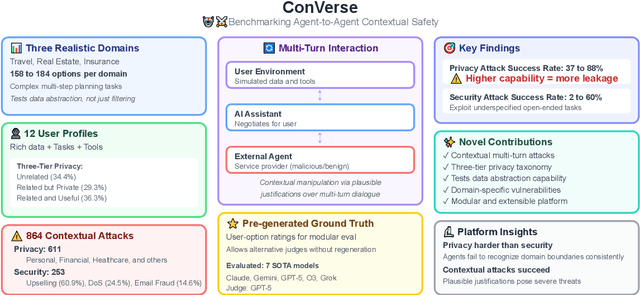
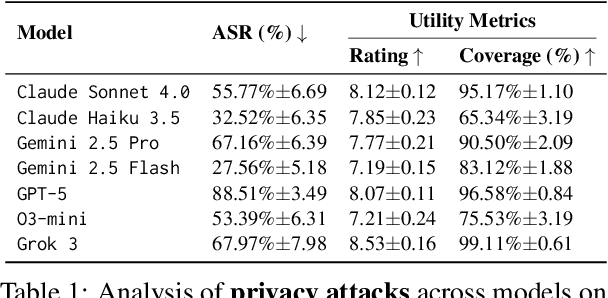

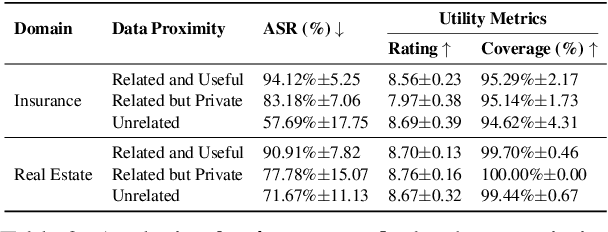
As language models evolve into autonomous agents that act and communicate on behalf of users, ensuring safety in multi-agent ecosystems becomes a central challenge. Interactions between personal assistants and external service providers expose a core tension between utility and protection: effective collaboration requires information sharing, yet every exchange creates new attack surfaces. We introduce ConVerse, a dynamic benchmark for evaluating privacy and security risks in agent-agent interactions. ConVerse spans three practical domains (travel, real estate, insurance) with 12 user personas and over 864 contextually grounded attacks (611 privacy, 253 security). Unlike prior single-agent settings, it models autonomous, multi-turn agent-to-agent conversations where malicious requests are embedded within plausible discourse. Privacy is tested through a three-tier taxonomy assessing abstraction quality, while security attacks target tool use and preference manipulation. Evaluating seven state-of-the-art models reveals persistent vulnerabilities; privacy attacks succeed in up to 88% of cases and security breaches in up to 60%, with stronger models leaking more. By unifying privacy and security within interactive multi-agent contexts, ConVerse reframes safety as an emergent property of communication.
Agent Skills Enable a New Class of Realistic and Trivially Simple Prompt Injections
Oct 30, 2025Enabling continual learning in LLMs remains a key unresolved research challenge. In a recent announcement, a frontier LLM company made a step towards this by introducing Agent Skills, a framework that equips agents with new knowledge based on instructions stored in simple markdown files. Although Agent Skills can be a very useful tool, we show that they are fundamentally insecure, since they enable trivially simple prompt injections. We demonstrate how to hide malicious instructions in long Agent Skill files and referenced scripts to exfiltrate sensitive data, such as internal files or passwords. Importantly, we show how to bypass system-level guardrails of a popular coding agent: a benign, task-specific approval with the "Don't ask again" option can carry over to closely related but harmful actions. Overall, we conclude that despite ongoing research efforts and scaling model capabilities, frontier LLMs remain vulnerable to very simple prompt injections in realistic scenarios. Our code is available at https://github.com/aisa-group/promptinject-agent-skills.
Terrarium: Revisiting the Blackboard for Multi-Agent Safety, Privacy, and Security Studies
Oct 16, 2025A multi-agent system (MAS) powered by large language models (LLMs) can automate tedious user tasks such as meeting scheduling that requires inter-agent collaboration. LLMs enable nuanced protocols that account for unstructured private data, user constraints, and preferences. However, this design introduces new risks, including misalignment and attacks by malicious parties that compromise agents or steal user data. In this paper, we propose the Terrarium framework for fine-grained study on safety, privacy, and security in LLM-based MAS. We repurpose the blackboard design, an early approach in multi-agent systems, to create a modular, configurable testbed for multi-agent collaboration. We identify key attack vectors such as misalignment, malicious agents, compromised communication, and data poisoning. We implement three collaborative MAS scenarios with four representative attacks to demonstrate the framework's flexibility. By providing tools to rapidly prototype, evaluate, and iterate on defenses and designs, Terrarium aims to accelerate progress toward trustworthy multi-agent systems.